Amazon Business Models Compared: Which Is Right for You? (2026)
Not all Amazon sellers are the same. The person selling $50,000/month in private label supplements operates a completely different business than someone flipping clearance items from Target.
Choosing the right business model is the most important decision you'll make as a new Amazon seller. The wrong choice leads to frustration, wasted money, and burnout. The right choice aligns with your capital, time, skills, and goals.
This guide breaks down the five main Amazon business models—honestly, with real pros and cons—so you can make an informed decision.
Quick Comparison
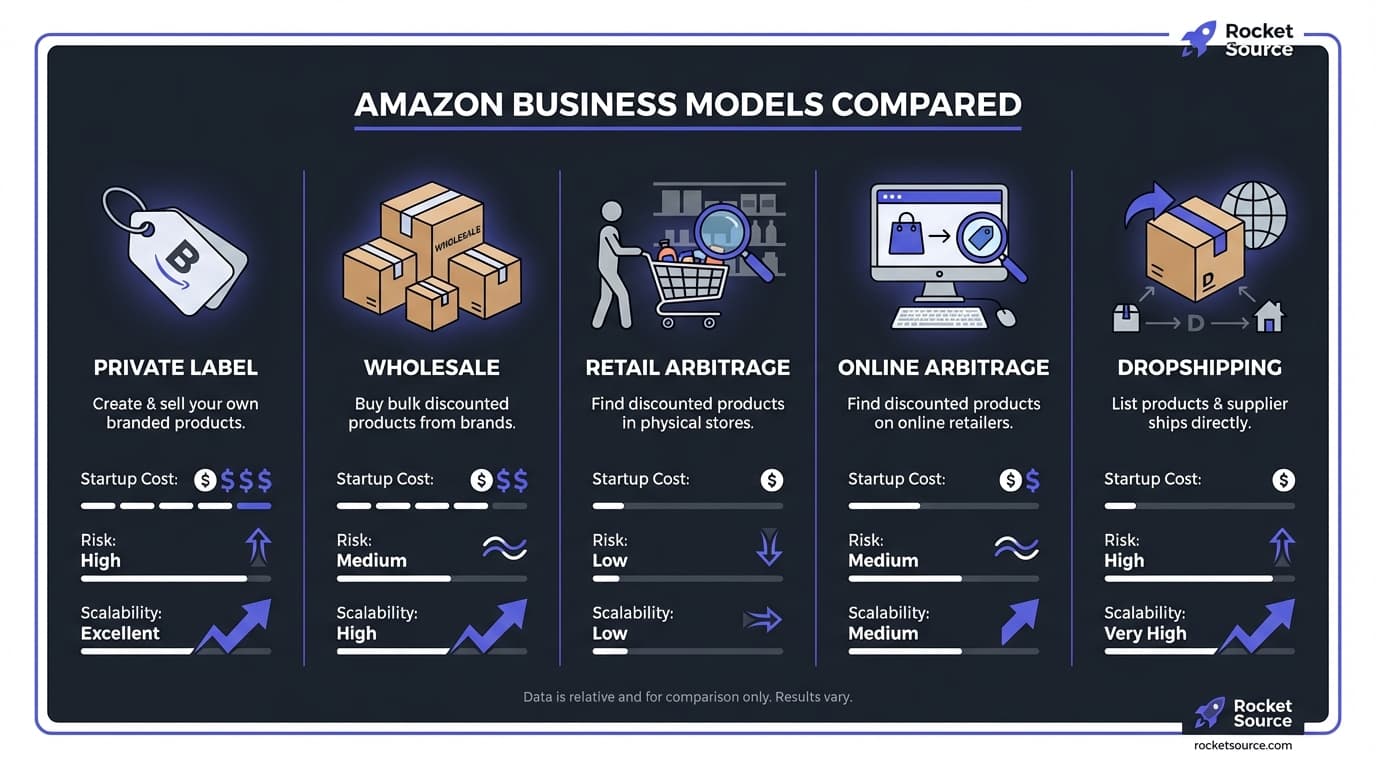
| Model | Startup Cost | Risk | Scalability | Time/Week | Best For |
|---|---|---|---|---|---|
| Private Label | $5K-$15K+ | High | Very High | 20-40 hrs | Brand builders with capital |
| Wholesale | $1K-$5K | Medium | High | 10-20 hrs | Systematic, analytical sellers |
| Retail Arbitrage | $200-$1K | Low | Low | 15-30 hrs | Beginners, side hustlers |
| Online Arbitrage | $500-$2K | Low | Medium | 10-25 hrs | Work-from-home sellers |
| Dropshipping | $100-$500 | Low | Low | 5-15 hrs | Testing (not long-term) |

Private Label
What It Is
You create your own branded products—typically manufactured overseas (often China)—and sell them exclusively under your brand on Amazon. You own the listing, the brand, and (ideally) the customer relationship.
Example: You find a popular yoga mat, work with a manufacturer to create your version with improved features, brand it "ZenFlex Yoga," and launch on Amazon with your own listing.
The Process
- Research product opportunities (demand + low competition)
- Find manufacturers (Alibaba, trade shows)
- Negotiate samples, pricing, minimums
- Place production order (500-3,000+ units typically)
- Create brand assets (logo, packaging, photography)
- Ship to Amazon FBA
- Launch with promotions, advertising, review generation
- Scale winners, cut losers
Pros
- Highest margins: 30-100%+ ROI possible
- Brand equity: Build an asset you can sell
- No Buy Box competition: You own the listing
- Control: Pricing, listing content, brand story—all yours
- Defensibility: Registered trademarks protect your niche
Cons
- High startup cost: $5,000-$15,000+ for first product
- Long timeline: 4-6 months from idea to first sale
- Significant risk: Product flops = major loss
- Complexity: Manufacturing, importing, branding, launching
- Ongoing investment: Advertising often required to maintain velocity
Realistic Expectations
- Success rate: Many estimates suggest 10-30% of private label products are profitable long-term
- Typical first product investment: $3,000-$5,000 (inventory) + $2,000-$5,000 (launch/advertising)
- Time to profitability: 6-12 months is common
- Margin: 20-40% net profit on successful products
Best For
Entrepreneurs with $10,000+ to invest, patience for a 6+ month timeline, willingness to learn product development and brand building, and goals of building a sellable business.
Wholesale
What It Is
You purchase existing brand-name products from authorized distributors or directly from brands at wholesale prices, then resell them on Amazon at retail prices. You're selling proven products with existing demand and reviews.
Example: You open an account with a beauty product distributor, buy popular shampoo brands at 50% off retail, and sell on existing Amazon listings alongside other sellers.
The Process
- Set up business entity (LLC, resale certificate)
- Find and apply to wholesale suppliers
- Request price lists (often 1,000-10,000+ products)
- Analyze products for profitability
- Place orders for profitable items
- Prep and ship to FBA (or use a prep center)
- Compete for Buy Box and sell
- Reorder winners, add new suppliers
Pros
- Lower risk: Selling products with proven demand
- Faster start: Weeks, not months
- Repeatable: Found a winner? Keep reordering
- Scalable: Add more suppliers = more opportunities
- Less creative work: No product development or photography
Cons
- Lower margins: 15-30% ROI typical (vs 30-100% private label)
- Competition: Multiple sellers on same listing
- Buy Box battles: Need competitive pricing and good metrics
- Supplier gatekeeping: Many reject Amazon sellers
- Capital intensive at scale: Inventory ties up cash
Realistic Expectations
- Time to first sale: 2-4 weeks after finding suppliers
- Typical starting capital: $1,000-$3,000 in inventory
- Margins: 10-20% net profit, 20-40% ROI
- Scaling: $10,000-$50,000/month revenue achievable in year one
Best For
Analytical sellers who want predictability over upside, those with $1,000-$5,000 to start, people who prefer systems over creativity, and anyone who wants a business that can run part-time.
Learn more: Complete Amazon Wholesale Guide
Retail Arbitrage (RA)
What It Is
You find discounted products at physical retail stores—clearance aisles, sales, liquidation—and resell them on Amazon for profit. Classic "buy low, sell high" with your local stores as the source.
Example: You find LEGO sets at 70% off at Target clearance, buy 20 units, and sell them on Amazon where they're still full price.
The Process
- Download Amazon Seller app
- Visit retail stores (Target, Walmart, CVS, etc.)
- Scan products with app to check Amazon prices
- Buy items where Amazon price > store price + fees + profit margin
- Prep and ship to FBA
- Sell and reinvest profits
- Repeat at more stores
Pros
- Lowest barrier to entry: Start with a few hundred dollars
- Immediate: Buy today, ship tomorrow
- Learn the platform: Hands-on education in Amazon selling
- Flexible: Work your own schedule
- Fun for some: Treasure hunting aspect
Cons
- Time intensive: Hours spent driving, scanning, hunting
- Inconsistent supply: Clearance isn't predictable
- Hard to scale: Limited by your time and local stores
- Store policies: Some retailers discourage resellers
- Competition: Other arbitrage sellers hunting the same deals
Realistic Expectations
- Hourly rate: $15-$30/hour equivalent is common
- Monthly profit: $500-$2,000 for part-time, $3,000-$5,000 full-time
- Scaling ceiling: Difficult to exceed $5,000-$8,000/month profit without employees
- Sustainability: Best as learning phase, not long-term model
Best For
Complete beginners with limited capital, those wanting to learn before larger investments, side hustlers who enjoy the hunt, and people testing if Amazon selling is for them.
Online Arbitrage (OA)
What It Is
Same concept as retail arbitrage, but you source deals from online retailers instead of physical stores. Work from home, source from anywhere with internet.
Example: You find a Bluetooth speaker on sale at Kohls.com for $30, sell it on Amazon for $55, profit $10 after fees.
The Process
- Use deal-finding tools and websites
- Check Amazon prices using UPC converters and calculators
- Buy from online retailers when profitable
- Have products shipped to you (or directly to prep center)
- Prep and ship to FBA
- Sell and reinvest
Pros
- Work from home: No driving to stores
- Broader inventory access: All of the internet vs local stores
- More scalable than RA: Can buy in larger quantities
- Automation potential: Tools can surface deals
Cons
- Inconsistent supply: Deals come and go
- Competition: Deals spread fast online
- Lower margins than wholesale: After shipping costs
- Anti-reseller measures: Some retailers cancel reseller orders
- Time investment: Still requires active sourcing
Realistic Expectations
- Monthly profit: $1,000-$4,000 part-time
- Time investment: 15-25 hours/week for $2,000-$3,000 profit
- Margins: 15-30% ROI on successful deals
- Scalability: Better than RA, but ceiling exists
Best For
Sellers who can't or don't want to go to physical stores, work-from-home parents, those building toward wholesale, and analytical people who enjoy deal hunting.
Related: Is Online Arbitrage Still Profitable in 2026?
Dropshipping
What It Is
You list products you don't own on Amazon. When a customer orders, you purchase from your supplier (often at retail), who ships directly to the customer. You never touch inventory.
Example: You list a specialty kitchen gadget. Customer orders for $40. You order from retailer for $25, have it shipped to customer, keep $15 minus fees.
The Process
- Find products with margin potential
- List on Amazon at markup
- When order comes in, buy from supplier
- Have supplier ship to customer (with no supplier branding)
- Pocket the difference minus fees
Pros
- Minimal investment: No inventory to buy upfront
- Low risk: Don't pay for products until they sell
- Test products: See what sells before investing in inventory
- Simple operations: No warehousing or shipping
Cons
- Amazon policy risks: Must meet strict requirements or face suspension
- Lowest margins: 5-15% typical after all costs
- No quality control: Supplier issues become your account issues
- Slow shipping: Customer experience suffers
- Race to bottom: Easy to copy = intense competition
Amazon's Dropshipping Rules
Amazon allows dropshipping only if:
- You are the seller of record
- You identify yourself as the seller on all packing slips/invoices
- No third-party branding visible to customer
- You handle all customer service and returns
Violating these rules = account suspension.
Realistic Expectations
- Margins: 5-15% on most products
- Account risk: Higher than other models
- Long-term viability: Low—most successful sellers transition to other models
- Best use case: Testing product ideas before committing to inventory
Best For
Testing whether products have demand before investing in inventory. Not recommended as a primary long-term Amazon business model due to margin and policy constraints.
Model Comparison: Deep Dive
By Startup Capital
| Capital Available | Recommended Model |
|---|---|
| Under $500 | Retail Arbitrage |
| $500-$1,500 | Online Arbitrage |
| $1,500-$5,000 | Wholesale |
| $5,000-$10,000 | Wholesale (scale) or Private Label (modest) |
| $10,000+ | Private Label or Wholesale at scale |
By Time Available
| Hours/Week | Recommended Model |
|---|---|
| 5-10 | Small-scale OA or Wholesale (VA-assisted) |
| 10-20 | Wholesale, Online Arbitrage |
| 20-30 | Retail Arbitrage, Wholesale scaling |
| 30+ | Private Label, any model at scale |
By Risk Tolerance
| Risk Profile | Recommended Model |
|---|---|
| Very low (can't lose money) | Retail/Online Arbitrage with tiny test orders |
| Low | Wholesale (small orders), mature OA |
| Medium | Wholesale at scale |
| High | Private Label |
By Goals
| Goal | Recommended Model |
|---|---|
| Learn the platform | Retail Arbitrage |
| Side income ($1-2K/mo) | Online Arbitrage |
| Replace job income | Wholesale |
| Build sellable business | Private Label or Wholesale brand |
| Maximize ROI on capital | Private Label (if successful) |
Hybrid Approaches
Many successful sellers combine models or transition between them.
Common Paths
Beginner Path:
Retail Arbitrage → Online Arbitrage → Wholesale → Private Label
Start simple, learn the platform, build capital, then graduate to more complex and profitable models.
Parallel Approach:
Wholesale (steady income) + Private Label (growth bets)
Use wholesale profits to fund private label experiments without risking everything on one product.
Diversification:
Multiple wholesale suppliers + 1-2 private label products + occasional arbitrage
Spread risk across models and income streams.

Which Model Should You Choose?
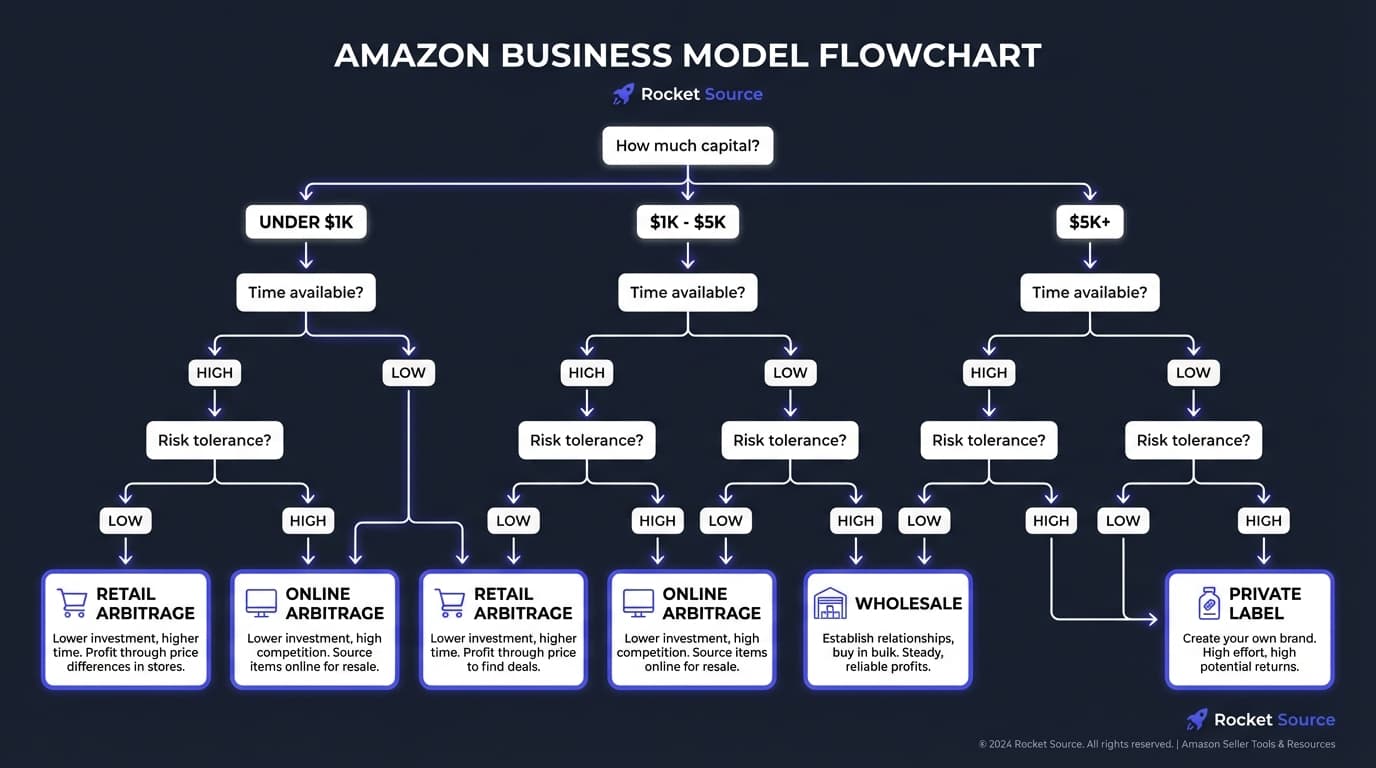
Decision Framework
Step 1: Assess your capital
- Under $1,000 → Arbitrage
- $1,000-$5,000 → Wholesale
- $5,000+ → Your choice
Step 2: Assess your time
- Part-time (10-15 hrs) → Wholesale or OA
- Full-time → Any model
Step 3: Assess your risk tolerance
- Risk-averse → Arbitrage or Wholesale
- Risk-tolerant → Private Label
Step 4: Assess your goals
- Learn first → Arbitrage
- Steady income → Wholesale
- Build brand → Private Label
Our Recommendation
For most new sellers, Wholesale offers the best balance:
- Lower risk than private label
- More scalable than arbitrage
- Systematic and repeatable
- Viable part-time or full-time
- Natural stepping stone to private label if desired
The combination of bulk product analysis tools, manageable capital requirements, and proven-product safety makes wholesale the smart choice for sellers who want to build a real business without betting everything on product launches.
Getting Started
No matter which model you choose:
- Create your Amazon Seller account
- Set up proper business structure (LLC recommended)
- Start small — test before scaling
- Track your numbers — know your actual profit
- Use tools to save time on research
Free resources to help:
- UPC to ASIN Converter — 50,000 conversions/week free
- FBA Prep Center Database — Find prep services
- Amazon Wholesale Guide — Complete walkthrough
Frequently Asked Questions
Can I do multiple business models at once?
Yes, and many sellers do. However, starting with one model until you're profitable, then adding others, usually works better than spreading yourself thin immediately.
Which model makes the most money?
Private Label has the highest potential earnings and margins—but also the highest failure rate and capital requirements. Wholesale offers more predictable, moderate returns. Choose based on your situation, not just maximum potential.
What's the easiest model to start?
Retail Arbitrage is simplest: download the Amazon app, go to a store, scan products, buy what's profitable. The barrier to entry is nearly zero. However, "easiest to start" doesn't mean "best long-term."
How do I know when to switch models?
Switch when you've hit the ceiling of your current model (arbitrage not scaling) or when you have capital and experience to graduate up (wholesale to private label). Many sellers transition after 6-12 months.
Is one model "better" than others?
No single model is best for everyone. Private label suits brand builders with capital. Wholesale suits analytical operators. Arbitrage suits beginners and side hustlers. Match the model to your situation.
Next Steps
- New to Amazon? Start with How to Become an Amazon Seller
- Interested in wholesale? Read our Amazon Wholesale Business Guide
- Considering arbitrage? See Is Online Arbitrage Still Profitable?
- Ready to analyze products? Try our free UPC converter
Ready to start your Amazon business?
Start Free with RocketSource →
Access product research tools, 50,000 free conversions per week, and our FBA Prep Database—no credit card required.