How to Become an Amazon Seller: Complete Beginner's Guide (2026)
Over 60% of Amazon sales come from third-party sellers—people like you running their own businesses on Amazon's marketplace. Whether you want a side income or a full-time business, becoming an Amazon seller is more accessible than ever.
This guide walks you through everything: account setup, business model options, realistic costs, and the path from complete beginner to your first sale.

The Amazon Opportunity in 2026
Amazon remains the dominant e-commerce platform in the US, with:
- 300+ million active customers worldwide
- $600+ billion in annual marketplace sales
- 60%+ of sales from third-party sellers
- Built-in trust, traffic, and infrastructure
You don't need to build a website, drive traffic, or convince customers to trust you. Amazon handles that. Your job is to find products people want to buy and get them listed.
Amazon Seller Account Types
Before anything else, understand your account options.
Individual Seller Account
- Cost: $0.99 per item sold (no monthly fee)
- Best for: Testing the waters, selling <40 items/month
- Limitations: No access to advanced selling tools, reports, or advertising
Professional Seller Account
- Cost: $39.99/month (no per-item fee)
- Best for: Serious sellers, anyone selling 40+ items/month
- Benefits: Full access to tools, reports, advertising, and bulk listings
The math: If you sell more than 40 items per month, Professional is cheaper. But beyond cost, Professional unlocks features you'll need to scale—advertising, detailed reports, and API access for tools.
Recommendation: Start with Individual if you're just testing. Switch to Professional once you're committed.
Amazon Business Models Explained
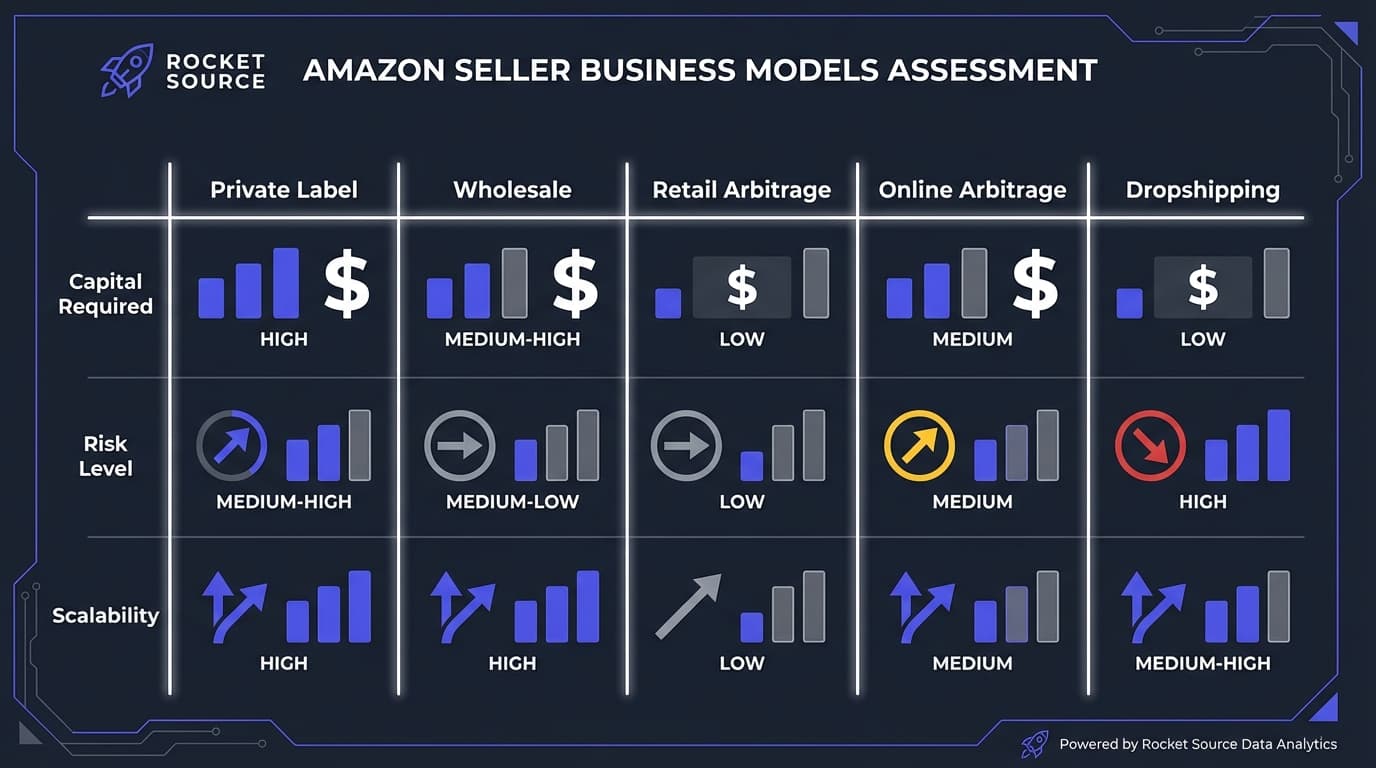
"Selling on Amazon" means different things to different people. Here are the main approaches:
Private Label
Create your own branded products, typically manufactured in China, and sell them exclusively on Amazon.
- Startup cost: $5,000-$15,000+
- Pros: Highest margins, brand equity, no competition on your listing
- Cons: Highest risk, requires product development, need to drive traffic/reviews
- Best for: Entrepreneurs with capital and patience
Wholesale
Purchase existing brand products from authorized distributors and resell on Amazon.
- Startup cost: $1,000-$5,000
- Pros: Lower risk (proven products), repeatable, scalable
- Cons: Competition on listings, lower margins than private label
- Best for: Systematic sellers who want predictability
For a complete guide, see Amazon Wholesale Business Guide.
Retail Arbitrage (RA)
Find discounted products at retail stores (clearance, sales) and resell on Amazon for profit.
- Startup cost: $200-$1,000
- Pros: Lowest barrier to entry, learn while earning
- Cons: Time-intensive, inconsistent supply, hard to scale
- Best for: Beginners testing the waters, side hustlers
Online Arbitrage (OA)
Same concept as retail arbitrage, but sourcing deals from online retailers instead of physical stores.
- Startup cost: $500-$2,000
- Pros: Work from home, broader deal access
- Cons: Still inconsistent, competitive
- Best for: Those who prefer working online
See our analysis: Is Online Arbitrage Still Profitable?
Dropshipping
List products you don't own. When a sale happens, your supplier ships directly to the customer.
- Startup cost: $100-$500
- Pros: No inventory investment, low risk
- Cons: Lowest margins, policy risks on Amazon, no quality control
- Best for: Testing product ideas (not recommended as primary model)
For a detailed comparison, see Amazon Business Models Compared.
Step-by-Step: Creating Your Seller Account
What You'll Need
Before starting registration, gather:
- Government-issued ID (driver's license or passport)
- Bank account (for receiving payments)
- Credit card (for seller fees)
- Phone number (for verification)
- Tax information (SSN for individuals, EIN for businesses)
Registration Process
- Go to sellercentral.amazon.com and click "Sign up"
- Choose Individual or Professional account
- Enter your personal/business information
- Verify your identity (Amazon may request video verification)
- Provide bank and tax information
- Complete the setup wizard
The process takes 15-30 minutes. Amazon may take 1-3 days to verify and approve your account. In some cases, they request additional documentation.
Seller Central Overview
Once approved, you'll access Seller Central—your dashboard for:
- Listing products
- Managing inventory
- Processing orders
- Viewing reports
- Running advertising
- Handling customer service
Spend time exploring before listing anything. Understand where things are.
Costs to Get Started
Be realistic about what it takes. Here's a breakdown by business model:
One-Time/Setup Costs
| Item | Cost |
|---|---|
| LLC formation | $50-$500 (varies by state) |
| Resale certificate | $0-$50 |
| Business bank account | $0 (usually free) |
| UPC codes (if needed)—see our GTIN guide | $250 for 100 from GS1 |
Ongoing Costs
| Item | Individual | Professional |
|---|---|---|
| Account fee | $0.99/item | $39.99/month |
| Referral fees | 8-15% of sale | 8-15% of sale |
| FBA fees | Per item | Per item |
Initial Inventory Investment by Model
| Model | Typical Starting Investment |
|---|---|
| Retail Arbitrage | $200-$1,000 |
| Online Arbitrage | $500-$2,000 |
| Wholesale | $1,000-$5,000 |
| Private Label | $5,000-$15,000+ |
Realistic Total to Start
| Level | Budget |
|---|---|
| Absolute minimum (RA) | $500 |
| Comfortable start (OA/Wholesale) | $2,000-$3,000 |
| Well-capitalized (Private Label) | $10,000+ |
You can start with very little. But undercapitalization limits your options and slows growth.
Choosing Your First Business Model
Not sure which model fits? Consider these factors:
Available Capital
| Budget | Best Fit |
|---|---|
| Under $500 | Retail Arbitrage |
| $500-$2,000 | Online Arbitrage |
| $2,000-$5,000 | Wholesale |
| $5,000+ | Private Label or Wholesale at scale |
Time Availability
| Availability | Best Fit |
|---|---|
| 5-10 hrs/week | Online Arbitrage, small Wholesale |
| 10-20 hrs/week | Wholesale, Retail Arbitrage |
| Full-time | Any model |
Risk Tolerance
| Risk Level | Best Fit |
|---|---|
| Low (can't afford to lose money) | Arbitrage (small test orders) |
| Medium (some risk acceptable) | Wholesale |
| High (comfortable with significant investment) | Private Label |
Our Recommendation for Beginners
Start with Retail or Online Arbitrage to learn the platform with minimal risk. Once you understand Amazon's systems, fees, and selling dynamics, transition to Wholesale for more predictable, scalable income.
Wholesale hits the sweet spot: lower risk than private label, more scalable than arbitrage, and a systematic approach that rewards process over luck.
Essential Tools for New Sellers
You don't need much to start, but certain tools save significant time.
Free Tools
| Tool | Purpose |
|---|---|
| RocketSource UPC Converter | Convert product codes to Amazon identifiers (50,000/week free) |
| Amazon Seller App | Scan products, manage inventory on mobile |
| Amazon Revenue Calculator | Estimate fees and profit for individual products |
| Keepa (browser extension) | View price and sales rank history |
Paid Tools (as you scale)
| Tool | Purpose | When to Get |
|---|---|---|
| Bulk scanning software | Analyze supplier lists | When doing wholesale |
| Repricer | Automate competitive pricing | When competing for Buy Box |
| Inventory management | Track stock, reordering | At $10k+/month revenue |
| Accounting software | Track true profitability | From day one (recommended) |
Don't over-invest in tools early. Start with free options, add paid tools as specific needs arise.
Common Beginner Mistakes
Learn from others' expensive lessons:
1. Jumping In Without Research
The sellers who struggle most are those who list products without understanding fees, competition, or demand. Spend time learning before spending money on inventory.
2. Choosing Saturated Products
"Everyone else is selling it" doesn't mean you should too. High competition means low margins and difficult Buy Box wins.
3. Underestimating Fees
Amazon's fees are complex: referral fees, FBA fees, storage fees, and more. A product that looks profitable at 30% margin might actually lose money after all fees.
See our complete fee breakdown.
4. Ignoring Account Health
Amazon monitors seller metrics closely. Poor performance (late shipments, high defect rates, policy violations) leads to account suspension. Protect your account like your business depends on it—because it does.
5. Over-Ordering Initially
Excitement leads to over-buying. Start small, validate that products sell as expected, then scale. It's better to run out of stock than to be stuck with inventory that doesn't move.
6. Neglecting the Numbers
Successful sellers know their numbers: cost per unit, fees, actual profit, ROI. Guessing leads to unpleasant surprises. Track everything from day one.
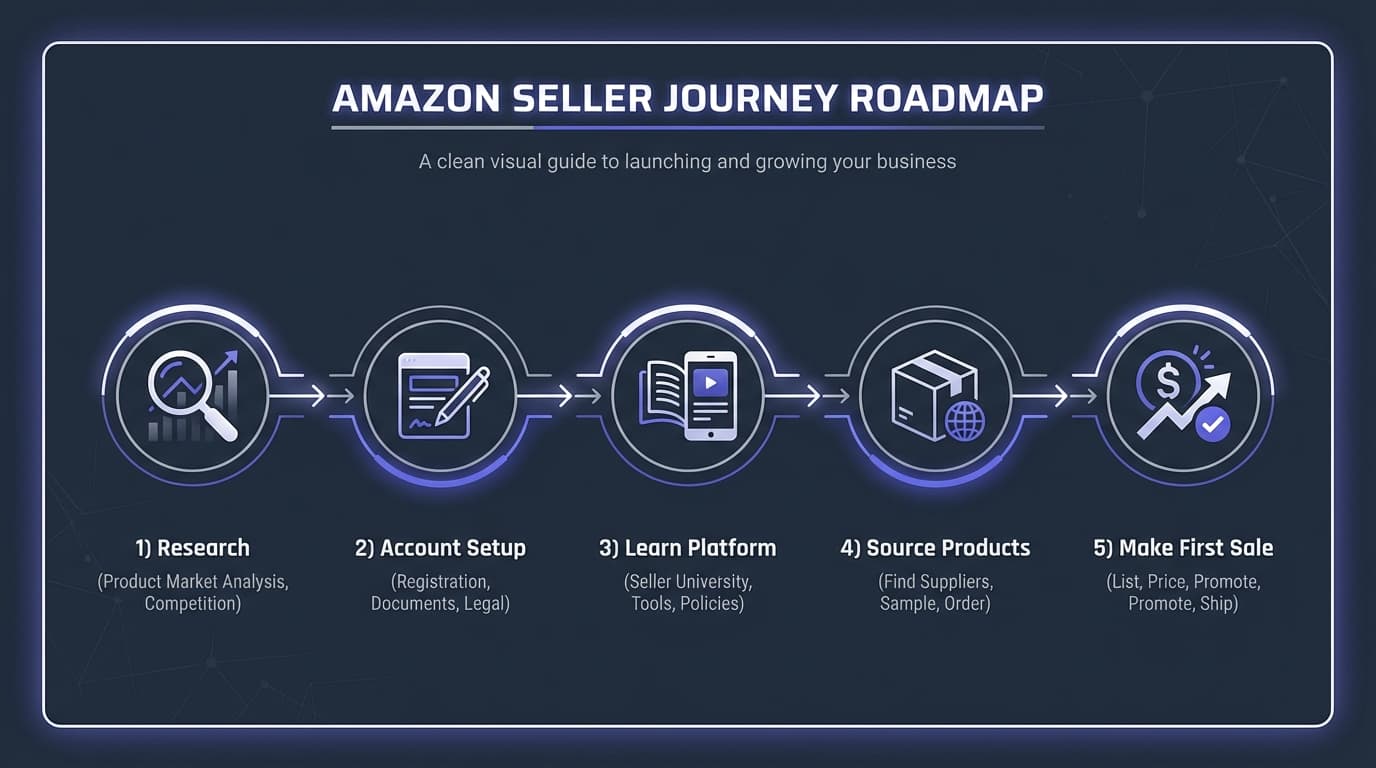
Your First 30 Days: A Roadmap

Week 1: Setup
- Create Amazon Seller account
- Set up business entity (LLC) and get EIN
- Obtain resale certificate
- Explore Seller Central
- Download Amazon Seller app
Week 2: Learning
- Understand fee structures
- Research your chosen business model
- Explore the free Amazon seller tools for identifiers, fees, pricing, and prep research
- Study category restrictions and gating
Week 3: Sourcing
- Find your first products (arbitrage: local stores or online deals)
- Or: Apply to wholesale suppliers and analyze price lists
- Calculate profitability for potential purchases
- Make your first small inventory purchase
Week 4: Selling
- Prep inventory for FBA (or list as FBM)
- Create your first shipment to Amazon
- List products and monitor for sales
- Learn from what works (and what doesn't)
Scaling Beyond the Basics
Once you've made your first sales and understand the fundamentals:
Short-term (Months 2-6)
- Expand product selection systematically
- If doing arbitrage: transition toward wholesale
- Build relationships with suppliers
- Optimize for profitability over revenue
Medium-term (Months 6-12)
- Add more suppliers/sourcing channels
- Implement inventory management systems
- Consider outsourcing prep to FBA prep centers
- Explore advertising (PPC)
Long-term (Year 2+)
- Negotiate better supplier terms
- Hire help (VAs, employees)
- Consider private label for higher margins
- Build toward a sellable business asset
Frequently Asked Questions
Is it too late to start selling on Amazon in 2026?
No. While competition has increased, so has the market. The key is choosing the right business model and niche. New sellers still succeed daily—they just need to be smarter than sellers who started when it was easier.
How much can I realistically make?
Varies wildly. Part-time arbitrage sellers make $500-$2,000/month profit. Full-time wholesale sellers typically range $3,000-$15,000/month. Top sellers exceed $50,000/month, but that takes years and significant capital.
Do I need a business license?
Technically, Amazon allows individual sellers without formal business entities. However, for wholesale (where suppliers require business documentation) and for liability protection, forming an LLC is strongly recommended.
Can I sell on Amazon from anywhere?
Amazon accepts sellers from most countries, though options vary by marketplace. US sellers have the most flexibility. International sellers can access US marketplace but face additional complexity (taxes, shipping, etc.).
Should I use FBA or fulfill orders myself (FBM)?
FBA is recommended for most sellers. It wins Buy Box more often, handles customer service and returns, and scales better. FBM makes sense for oversized items, slow sellers, or when testing products before committing to FBA.
What categories should I start with?
Avoid gated categories (requires approval—see our gating guide) and complex categories (clothing sizes, electronics returns) initially. Good starting points: Home & Kitchen, Toys & Games, Health & Beauty, Grocery.
Next Steps
Ready to begin? Here's your action plan:
- Create your Amazon Seller account (Individual to start, upgrade later)
- Decide on your business model based on capital and time
- Choose the right starting point in the free seller tools hub
- Find your first products and calculate true profitability
- Make a small test purchase and list your first items
- Learn, adjust, and scale based on real results
Related Guides
- Amazon Business Models Compared — Detailed breakdown of each model
- Amazon Wholesale Business Guide — Complete wholesale walkthrough
- Amazon Seller Fees Explained — Understand every fee
- Free UPC to ASIN Converter — Start researching products today
- What Is an ASIN? — Understand Amazon product identifiers
- Amazon Barcode Types Explained — UPC, EAN, FNSKU, and more
Ready to become an Amazon seller?
Start Free with RocketSource →
Access our free product research tools, UPC converter (50,000/week), and FBA Prep Database—no credit card required.