Amazon Seller Fees 2026: Referral, FBA, and Storage Fee Guide
Amazon fees can make or break your profitability. A product that looks like a winner with 30% margins might actually lose money once you account for all fees.
This guide breaks down Amazon seller fees for 2026, including referral fees, FBA fulfillment fees, storage costs, and real examples. Understanding fees before sourcing products is essential, not optional.
Checking one product? Use the free FBA calculator and Amazon price history checker.
Working from a supplier list? Start with a product identifier. Try the UPC to ASIN converter, ISBN converter, or ASIN to UPC converter.
Why Fees Matter So Much
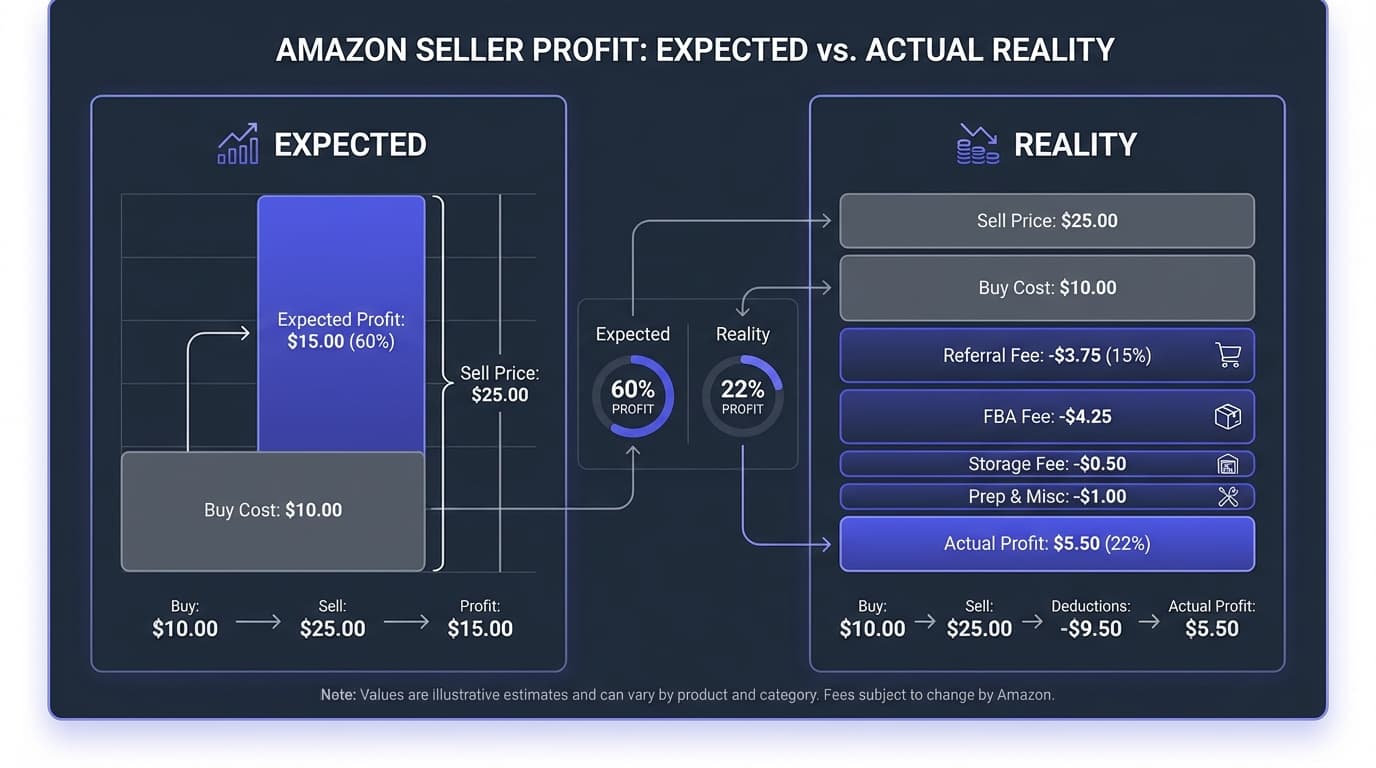
New sellers consistently underestimate fees. Here's a common scenario:
What they think:
- Buy product for $10
- Sell for $25
- Profit: $15 (60% margin!)
What actually happens:
- Buy product for $10
- Sell for $25
- Referral fee (15%): -$3.75
- FBA fee: -$4.50
- Storage, prep, inbound: -$1.25
- Actual profit: $5.50 (22% margin)
Still profitable, but dramatically different from expectations. And that's assuming everything goes right. Returns, storage fees, and price competition can erode margins further.

Fee Categories Overview
The tables below summarize the US seller fee structure for 2026. For final rates and policy details, check Amazon's selling fee schedule, referral fee page, and 2026 FBA fee changes.
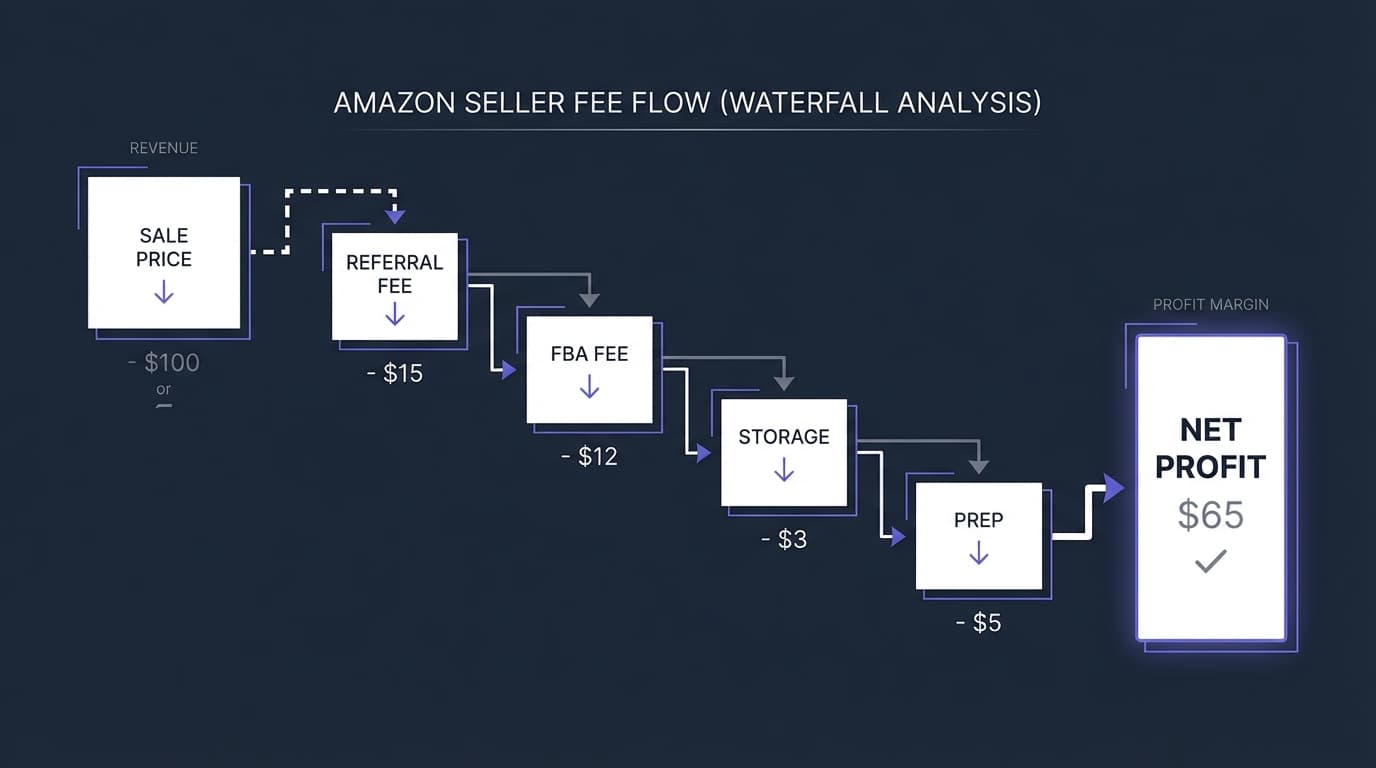
| Fee Type | When It Applies | Typical Range |
|---|---|---|
| Account subscription | Monthly | $0-$39.99/month |
| Referral fee | Per sale | 6-45% (most: 8-15%) |
| FBA fulfillment | Per unit (FBA only) | $3-$15+ |
| Storage | Monthly (FBA only) | $0.56-$2.40/cu ft |
| Other FBA fees | Various situations | Varies |
Let's examine each in detail.
Account Subscription Fees
Individual Plan
- Cost: $0.99 per item sold
- Best for: Sellers with <40 sales/month, testing the platform
Professional Plan
- Cost: $39.99/month (no per-item fee)
- Best for: Serious sellers, anyone with 40+ sales/month
The math: If you sell 40+ items monthly, Professional saves money. Beyond cost, Professional includes essential tools: advertising, detailed reports, bulk listing, and API access.
Recommendation: Start with Individual if just testing. Switch to Professional when you're committed to building a business.
Referral Fees
Amazon's commission on every sale is the platform's primary revenue from third-party sellers.
How It Works
Referral fee = Sale price x Category percentage
The "sale price" includes the item price and any shipping charged to the customer (for seller-fulfilled orders).
Referral Fee Rates by Category (2026)
| Category | Referral Fee |
|---|---|
| Amazon Device Accessories | 45% |
| Jewelry | 20% (5% for items >$250) |
| Watches | 16% (up to $1,500) |
| Clothing & Accessories | 17% |
| Shoes, Handbags, Sunglasses | 15% |
| Most Categories | 15% |
| Consumer Electronics | 8% |
| Personal Computers | 6% |
| Video Game Consoles | 8% |
| Books, Music, Video, DVD | 15% |
| Grocery & Gourmet | 8% (15% for items >$15) |
| Health & Personal Care | 8% (15% for items >$10) |
| Beauty | 8% (15% for items >$10) |
Minimum Referral Fee
Most categories have a minimum referral fee of $0.30. For very low-priced items, this minimum kicks in.
Example: A $2.00 item with 15% referral fee would be $0.30 (not $0.30 calculated fee, which would only be $0.30).
Category Matters
Selling in the right category significantly impacts margins:
- $20 electronics item: $1.60 referral fee (8%)
- $20 home & kitchen item: $3.00 referral fee (15%)
Same price, almost double the fee difference.
FBA Fulfillment Fees
If you use Fulfillment by Amazon (FBA), Amazon charges per-unit fees for picking, packing, and shipping orders.
How FBA Fees Work
FBA fees are based on:
- Product size tier (dimensions and weight)
- Shipping weight (actual or dimensional, whichever is greater)
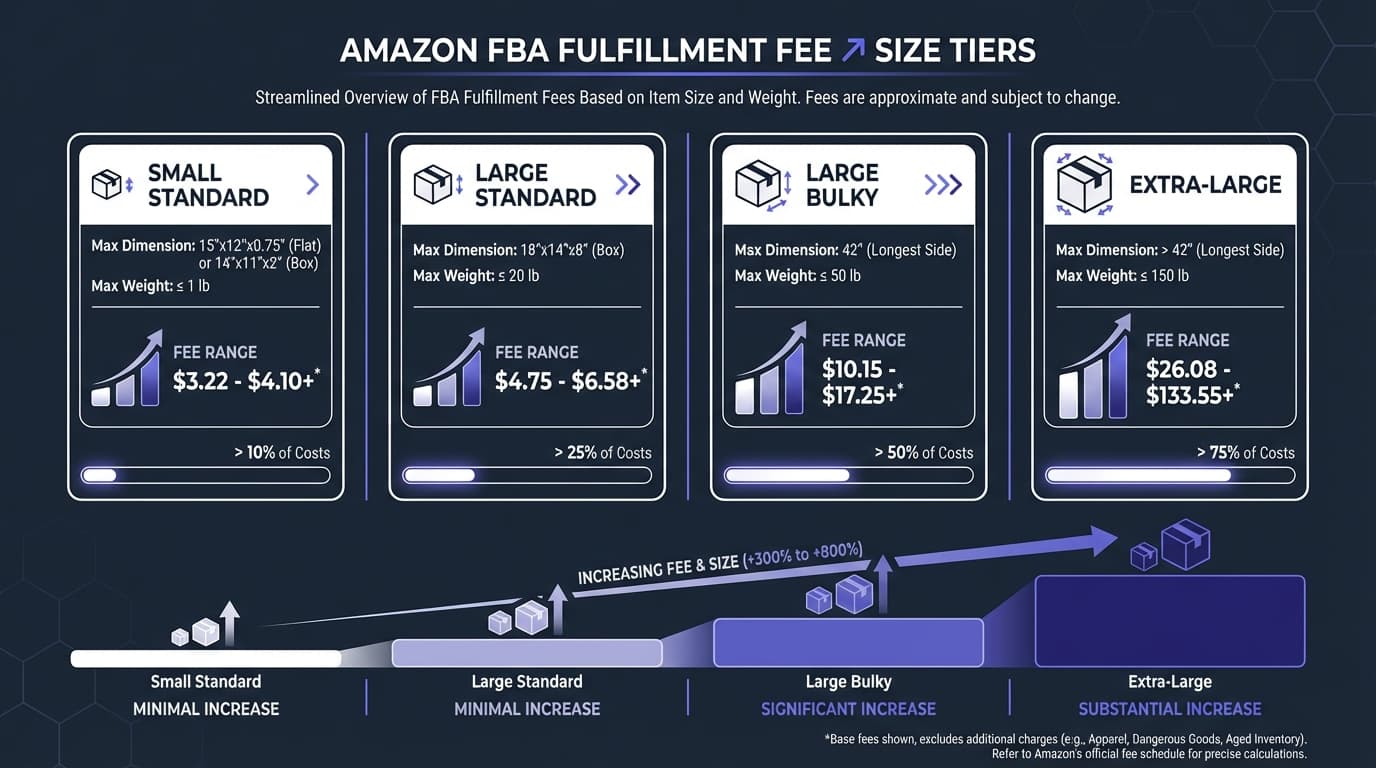
Size Tiers (2026)
| Size Tier | Max Dimensions | Max Weight |
|---|---|---|
| Small Standard | 15" x 12" x 0.75" | 1 lb |
| Large Standard | 18" x 14" x 8" | 20 lb |
| Large Bulky | 59" x 33" x 33" | 50 lb |
| Extra-Large (0-50 lb) | 108" max side | 50 lb |
| Extra-Large (50-70 lb) | 108" max side | 70 lb |
| Extra-Large (70-150 lb) | 108" max side | 150 lb |
FBA Fee Rates (2026 Non-Peak)
Amazon announced 2026 FBA fee changes for US sellers, including average increases for standard-size products and a fuel and logistics surcharge that applies from April 17, 2026. Use these tables as a planning reference, then confirm the exact fee for each product before you buy inventory.
Small standard:
| Shipping Weight | FBA Fee |
|---|---|
| 2 oz or less | $3.06 |
| 2 to 4 oz | $3.15 |
| 4 to 6 oz | $3.24 |
| 6 to 8 oz | $3.33 |
| 8 to 10 oz | $3.43 |
| 10 to 12 oz | $3.53 |
| 12 to 14 oz | $3.60 |
| 14 to 16 oz | $3.65 |
Large standard:
| Shipping Weight | FBA Fee |
|---|---|
| 4 oz or less | $3.68 |
| 4 to 8 oz | $3.90 |
| 8 to 12 oz | $4.15 |
| 12 oz to 1 lb | $4.55 |
| 1 to 1.5 lb | $5.05 |
| 1.5 to 2 lb | $5.40 |
| 2 to 2.5 lb | $5.70 |
| 2.5 to 3 lb | $6.05 |
| 3+ lb | $6.05 |
| Above 3 lb | $6.05 + $0.32 per additional half-pound |
Large bulky:
| Shipping Weight | FBA Fee |
|---|---|
| $9.61 + $0.38/lb above first lb | $9.61 |
| Above 1 lb | $9.61 + $0.38 per additional pound |
Extra-large:
| Shipping Weight | FBA Fee |
|---|---|
| 0 to 50 lb | $26.33 |
| 50 to 70 lb | $40.12 |
| 70 to 150 lb | $54.90 |
Apparel Fees
Clothing has slightly different rates, generally $0.10-$0.20 lower than non-apparel in the same size tier.
Peak Season Surcharges
During Q4 (October 15 - January 14), FBA fees increase by approximately $0.20-$1.00 per unit depending on size.
Storage Fees
FBA inventory sitting in Amazon's warehouses incurs monthly storage fees.
Monthly Storage Rates (2026)
| Period | Standard-Size | Oversize |
|---|---|---|
| January - September | $0.78/cu ft | $0.56/cu ft |
| October - December | $2.40/cu ft | $1.40/cu ft |
How Storage Is Calculated
Storage fee = (Cubic feet) x (Daily average units) x (Monthly rate) / (Days in month)
Example:
- Product dimensions: 10" x 8" x 4" = 0.19 cubic feet
- 100 units stored average in March
- Storage fee: 0.19 x 100 x $0.78 = $14.82/month
Aged Inventory Surcharge
Inventory stored 181+ days incurs additional fees:
| Days in Inventory | Surcharge per Cubic Foot |
|---|---|
| 181-210 days | $0.50 |
| 211-240 days | $1.00 |
| 241-270 days | $1.50 |
| 271-300 days | $2.00 |
| 301-330 days | $2.50 |
| 331-365 days | $3.00 |
| 365+ days | $6.90 or $0.15/unit (whichever greater) |
The lesson: Don't send slow-selling inventory to FBA. Aged inventory fees will eat your profits.
Other FBA Fees
Removal and Disposal Fees
Getting inventory out of FBA:
| Size | Removal Fee | Disposal Fee |
|---|---|---|
| Standard | $0.97/unit | $0.32/unit |
| Oversize | $1.98/unit | $0.97/unit |
Return Processing Fees
For categories with free returns (apparel, shoes, watches, etc.):
- Fee equals FBA fulfillment fee per returned unit
Unplanned Service Fees
If your products arrive at FBA improperly prepped:
| Service | Fee |
|---|---|
| Labeling | $0.55/unit |
| Polybagging | $1.00/unit |
| Bubble wrap | $1.60/unit |
| Taping | $0.60/unit |
Avoid these: Prep correctly before shipping.
Inbound Placement Service Fee
Amazon may split your shipment across multiple fulfillment centers. You can pay to send to fewer locations:
- Minimal splits: $0.27-$1.58/unit depending on size
- Partial splits: $0.15-$0.68/unit depending on size
Seller-Fulfilled (FBM) Fees
If you fulfill orders yourself (FBM or SFP), you avoid FBA fees but face other costs:
What You Still Pay
- Referral fees (same as FBA)
- Account subscription (same as FBA)
- Your own shipping costs
- Packaging materials
- Labor costs
Shipping Credits
Amazon provides shipping credits for seller-fulfilled orders, but they often don't cover actual shipping costs, especially for heavy items.
When FBM Makes Sense
- Very large/heavy items where FBA fees are extreme
- Slow-selling items (avoid storage fees)
- Items you already stock for other channels
- Testing products before committing to FBA
Hidden and Unexpected Costs
Beyond Amazon's direct fees:
Prep Costs
- DIY supplies: Labels, polybags, boxes (~$0.30-$0.75/unit)
- Prep center: $0.75-$2.00/unit for full prep
Inbound Shipping
Shipping inventory to Amazon FBA:
- UPS/FedEx partnered rates: $0.30-$1.00/unit
- LTL for pallets: Lower per-unit but minimum volumes
Returns
- Customer returns reduce profit
- Returned items may be unsellable
- Return processing fees for applicable categories
Advertising
PPC advertising often necessary for visibility:
- Typical ACoS (advertising cost of sale): 15-30%
- Factor into profitability calculations
Reimbursement Shortfalls
Amazon sometimes loses or damages inventory. Reimbursements don't always cover full value.
Calculating True Profitability
The Complete Formula
Net Profit = Sale Price
           - Product Cost
           - Referral Fee
           - FBA Fee (if applicable)
           - Prep Cost
           - Inbound Shipping
           - Storage (allocated per unit)
           - Advertising (allocated per unit)
           - Returns allowance
Example Calculation
Product: Kitchen gadget, small standard size (8 oz)
| Component | Amount |
|---|---|
| Sale price | $24.99 |
| Product cost | -$8.00 |
| Referral fee (15%) | -$3.75 |
| FBA fee (8 oz standard) | -$3.33 |
| Prep cost | -$0.50 |
| Inbound shipping | -$0.50 |
| Storage (30 days avg) | -$0.15 |
| Returns allowance (5%) | -$1.25 |
| Net profit | $7.51 |
| Margin | 30% |
| ROI | 81% |
This is a healthy deal. But notice how the profit went from apparent $16.99 gross margin to $7.51 actual profit.
Why Spreadsheets Don't Scale
For one product, manual calculation works. For analyzing a supplier price list with 5,000 products? Impossible.
This is why sellers use calculators and bulk analysis tools before they buy inventory. Start with the free FBA calculator for one product. For supplier files, RocketSource can upload a CSV with costs and return profitability analysis for every product, including referral fees, FBA fees, and net profit.
If your supplier list uses product identifiers instead of ASINs, convert those first with the UPC to ASIN converter or EAN to ASIN converter.
Strategies to Minimize Fees
Choose Categories Wisely
8% referral fee (electronics) vs 15% (most categories) makes a massive difference at scale.
Optimize Product Size
Small standard products have the lowest FBA fees. When possible, source products that fit this tier.
Manage Inventory Velocity
- Don't overstock slow sellers
- Remove aged inventory before surcharges hit
- Use sales velocity to predict optimal quantities
Negotiate Better Costs
Lower product costs = higher margins after fixed fees:
- Volume discounts from suppliers
- Better shipping rates at scale
- Prep center negotiations
Use FBA Strategically
Not everything belongs in FBA:
- Slow sellers: Consider FBM or don't carry
- Heavy/large items: Calculate if FBA makes sense
- Seasonal items: Time inventory carefully
Frequently Asked Questions
What are the main Amazon seller fees in 2026?
The main fees are the account subscription fee, referral fee, FBA fulfillment fee if you use FBA, monthly storage fee, inbound placement fee, return-related fees, and any prep or removal fees that apply to your inventory.
How much is the Amazon referral fee?
Referral fees vary by category. Many categories are around 15% of the total sales price, while some categories use lower rates, higher rates, or price-banded rates. Most categories also have a minimum referral fee.
How are FBA fees calculated?
FBA fulfillment fees are based mainly on product size tier, shipping weight, product price, and whether the item is apparel or non-apparel. Storage, inbound placement, returns, and prep can add more cost.
How do I calculate profit after Amazon fees?
Start with sale price, then subtract product cost, referral fee, FBA fee, inbound shipping, prep, storage, advertising, and a returns allowance. For bulk sourcing, use a calculator or upload a supplier file so every row is calculated the same way.
Do Amazon fees change by marketplace?
Yes. The US, UK, Germany, Canada, and other marketplaces each have their own fee schedules. Always check the fee schedule for the marketplace where you plan to sell.
What's the minimum profit margin I should target?
Most successful sellers target:
- Net profit margin: 15%+ minimum, 20%+ preferred
- ROI: 30%+ minimum, 50%+ preferred
Below these thresholds, there's little room for error.
Next Steps
- Free FBA Calculator - Calculate fees, profit, margin, and ROI for one product
- How to Calculate FBA Fees - Step-by-step calculation guide
- Amazon Wholesale Guide - Build a profitable wholesale business
- Free UPC Converter - Start analyzing products today
Want to calculate fees automatically across thousands of products?
Upload supplier price lists, get quick profitability analysis including all Amazon fees. No credit card required.